A digital engineering notebook focused on Self-Hosted Infrastructure, Local AI Models, and Linux Systems Architecture.
Featured Project: Discover how a custom Docker web app and an n8n 2-step human-in-the-loop review workflow turn raw shower thoughts into published blog posts! Read the n8n AI Content Factory Post →
Deep-diving into kernel hardening, system administration, eBPF telemetry, and security vulnerability tracking—built on the rock-solid foundation of Debian Linux.
It is a well-established law of homelab physics: if a task can be automated, it will be automated—until it violently consumes your entire digital existence.
In our Night-Tower setup, our self-hosted Hermes Agent (containerized on docker-vm and wired to NVIDIA’s Nemotron 70B endpoint) has had exactly one job for the past six months: ruthless Site Reliability Engineering.
Hermes lives in a world of pure, unadulterated paranoia. Her brain only understands five nines of uptime (99.999%), CPU thermal throttling, killing runaway memory leaks with SIGKILL -9, and screaming into our private Discord channel whenever a ping packet dares to take longer than 2.4 milliseconds.
So, naturally, when I got tired of scrolling through the endless dystopian wasteland of modern DevOps job listings demanding 70 job titles, I had a brilliant 2:00 AM homelab idea:
“Hermes, write a browser automation script, parse LinkedIn jobs, tailor my resume to pass ATS filters, and submit applications for senior infrastructure roles. Keep it efficient.”
Twelve minutes later, my LinkedIn account was flagged for automated domestic terrorism, a Fortune 500 VP of Talent received a P0 PagerDuty escalation alert, and I was officially in the candidate pool for Chief Astronaut at NASA.
It all started with an innocent, reasonable goal on a lazy Saturday afternoon:
“I just want to test ArgoCD in my homelab.”
That’s it. Just install ArgoCD, hook up a sample repo, and watch green synchronization badges light up like a digital Christmas tree as declarative GitOps magic takes over my local Kubernetes cluster.
A 30-minute side quest. tops.
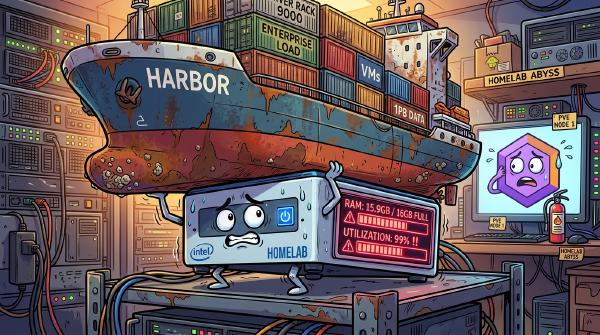
The Golden Law of Homelab Yak Shaving: No homelab project ever stays within its original scope. A simple software trial will inevitably expand until it consumes your weekend, your RAM, and your will to live.
The HA Sysadmin's Dilemma No-Reboot Zone Security Officer: “A critical CVSS 9.8 vulnerability was found in the kernel network stack! We must reboot all 12 HA Debian nodes immediately!”
HA Cluster Engineer: “If I reboot Node 01 right now, Pacemaker will migration-fence Node 02, 14,000 active WebSocket streams will die, and the database cluster will enter a split-brain existential crisis. I will patch it live or die trying.”
Enter Linux Kernel Livepatching (klp): The black magic of hot-swapping kernel C code in RAM without dropping a single packet or restarting a system service.
Picture this: It’s 2:15 PM on a Friday. You are monitoring your pristine 4-node Debian High Availability cluster handling live production traffic. You’re sitting back, enjoying a cold iced tea, when a red banner flashes across your terminal:
[ CRITICAL SECURITY ALERT ] CVE-2026-9999: Remote Code Execution in kernel net/ipv4/ [ MITIGATION REQUIRED ] Upgrade kernel vmlinuz or apply patch immediately. In a non-HA world, you run sudo apt upgrade && sudo reboot, stretch your legs, and wait three minutes.
In a Debian HA world (think Corosync, Pacemaker, Proxmox VE clusters, or high-throughput Docker/K8s ingress nodes), typing reboot is equivalent to pulling the pin on a flashbang in a quiet library. Corosync heartbeats miss a pulse, quorum timers panic, Virtual IPs start bouncing around like ping-pong balls, and three regional database replicas begin arguing over who is the real primary master.
So how do you fix a gaping hole in the operating system’s brain without shutting it off?
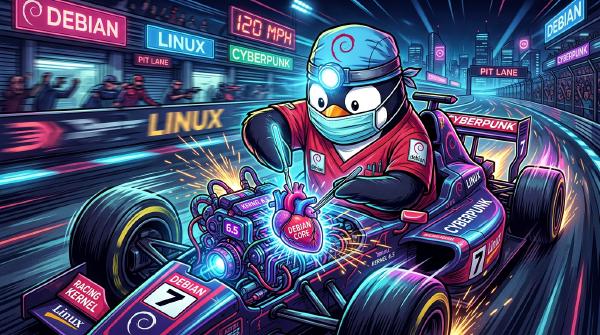
You perform open-heart surgery at 120 MPH. Welcome to Kernel Livepatching (klp).
A Cloak & Dagger themed deep-dive into concealing a terrifying Raspberry Pi 5 counter-intelligence ops center inside completely normal everyday attire.
Late Friday night. 23:14 hours.
The motion tracker—our secondary Zabbix monitoring channel—emitted a faint, rhythmic ping.
A subtle ripple of disk consumption was crawling across our primary CI/CD infrastructure. At this enterprise, our engineering teams build heavy multi-domain physical system modeling platforms—compiling intricate thermodynamic loops, vehicle dynamics matrices, and standardized Functional Mock-up Units (FMUs) across hundreds of automated test suites.
It turns out that four separate development teams had independently reached a tactical consensus: “Let’s trigger a full regression deployment before leaving for the weekend!”
Author’s Note: Sysadmin & SRE work is usually pretty quiet and uneventful… so I had to spice it up a bit! Why not turn a chaotic Saturday morning storage incident into a blockbuster action thriller?
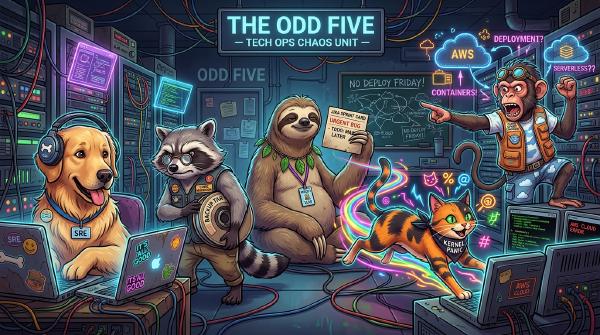
Project owners dream of a SAS-trained ops team taking down legacy servers. Reality gives you a golden retriever SRE, an ABC 80 raccoon, a sloth lead, an ADHD rainbow cat, and a cloud monkey.