
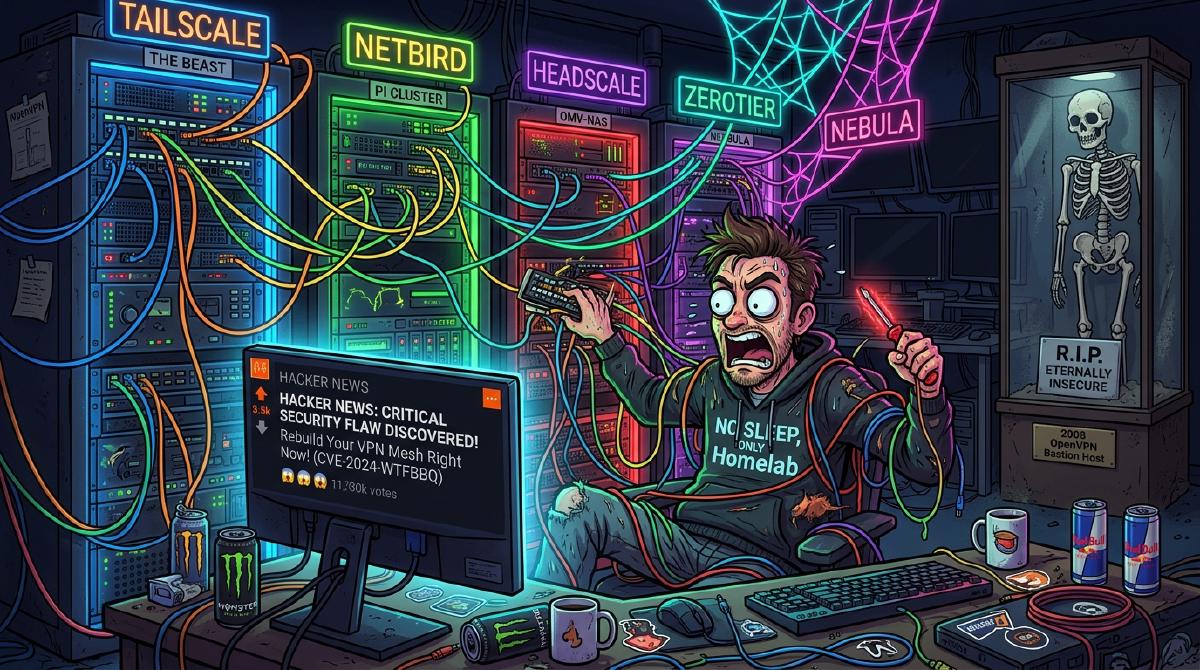
It is 11:42 PM on a Sunday. Your homelab is purring softly. The Grafana dashboards are all green, Plex is transcoding smoothly for your cousin in Ohio, and your local DNS is resolving ad-free at blistering speeds. You take a satisfying sip of tea and open HackerNews for a quick nightcap.
Then you see it.
“Show HN: Minor Telemetry Edge-Case Found in [Your Current VPN’s] Key Exchange Protocol”
Panic sets in. Your heart rate spikes to 140 BPM. Your teeth chatter. Within four minutes, you have opened a terminal, SSH’d into your core router, deleted your configuration files, and embarked on a full 3 AM infrastructure rewrite—leaving your spouse entirely unable to watch The Office on local Wi-Fi.
Welcome to the Great Homelab Mesh VPN Paranoia.
The Ancient Era: The Bastion Host Trauma (2008–2018)#
Before we talk about modern overlay meshes, let us pay respect to the elder homelabbers who survived the Dark Ages of remote access.
Back in 2008, accessing your home server from outside meant one thing: The Bastion Host.
[ Insecure Internet ] ──> [ ISP Router Port 1194 ] ──> [ OpenVPN / FreeRADIUS Bastion ] ──> [ Internal Subnet ]easy-rsa certificate authority scripts, and setting up a dedicated FreeRADIUS server just so your smartphone could fetch a file from your Samba share.One expired client certificate on a Tuesday afternoon, and you were permanently locked out of your own network while standing in line at the grocery store. If you lost your private key, your only option was physical intervention with a console cable and a stiff drink.
Thank goodness we evolved. Or did we?
The Contenders: Choosing Your Poison#
Today, we are spoiled for choice. But having six brilliant mesh VPN solutions doesn’t make life easier—it just gives you six distinct ways to overthink your life choices.
1. Tailscale: The Gateway Drug Everyone Loves (Until HN Speaks)#
Tailscale is the undisputed king of “it just works.” Built on top of WireGuard, it configures NAT traversal, DERP relays, and split DNS in roughly 30 seconds flat. You log in with your Google or GitHub account, click “Connect,” and suddenly your laptop in a coffee shop can ping your Raspberry Pi in your basement.
The Homelab Paranoia Factor: High. The coordination server is proprietary and hosted by Tailscale Inc. The moment someone on Reddit writes a 4,000-word essay titled “Why Cloud Coordination Servers Are an Anti-Pattern,” you will feel dirty using it and immediately start looking for self-hosted alternatives.
2. Headscale: The Open-Source Purist’s Fortress#
Headscale is the open-source, self-hosted implementation of the Tailscale control server. It lets you use official Tailscale client apps on your phone and laptop, but all node coordination, key exchanges, and ACLs stay on your own hardware.
headscale nodes register --key xyz... within a 120-second window, and praying your mobile client doesn’t crash.The Homelab Paranoia Factor: Low on privacy, High on maintenance. You will spend 4 hours debugging SQLite database locks or OIDC integration with Keycloak just to prove a point to random people on Matrix.
3. NetBird: The Enterprise Challenger (eBPF + OAuth)#
NetBird is a fast-growing open-source WireGuard mesh network featuring kernel-level eBPF packet routing, built-in posture checks, and native multi-user identity provider support (Zitadel, Keycloak, Auth0, Okta).
┌──────────────────────────────────────────────────────────────────────────┐
│ NetBird Self-Hosted Stack                                                │
│ ┌──────────────┐ ┌─────────────┐ ┌──────────────┐ ┌─────────────┐        │
│ │ Management   │ │ Signal      │ │ Coturn (STUN)│ │ Dashboard   │        │
│ └──────────────┘ └─────────────┘ └──────────────┘ └─────────────┘        │
│ ┌───────────────────────────────────────────────────────────────┐        │
│ │ Identity Provider (Zitadel / Keycloak / Authelia)             │        │
│ └───────────────────────────────────────────────────────────────┘        │
└──────────────────────────────────────────────────────────────────────────┘
The Good: Full eBPF routing support, beautiful web dashboard, and genuine zero-trust access rules per device group.
The Homelab Paranoia Factor: Self-hosting NetBird requires running 6 to 8 Docker containers simultaneously. Your docker-compose.yml file will read like a Russian novel. If one container drops its database connection during an update, your remote access vanishes into the void.
4. ZeroTier: The Virtual Software Switch#
Unlike WireGuard-based solutions that operate as Layer 3 routed networks, ZeroTier creates a virtual Layer 2 Ethernet switch across the internet. Devices connect as if they were plugged into the exact same physical unmanaged switch.
The Homelab Paranoia Factor: Every node gets assigned a cryptic 10-digit hexadecimal address (1d3f8a92e1). Self-hosting the ZeroTier central planet/moon controllers is notoriously esoteric, leaving most homelabbers dependent on ZeroTier’s cloud controller.
5. Nebula: The Slack-Designed Certificate Fortress#
Developed by Slack to connect tens of thousands of servers across global clouds, Nebula is a portable, ultra-lightweight overlay network built on mutual TLS certificate authentication and peer-to-peer discovery via “Lighthouses.”
The Good: Absolutely rock solid. Zero central control server runtime dependency once certificates are issued. It handles NAT traversal like a champion and runs on microcontrollers with virtually zero CPU overhead.
The Homelab Paranoia Factor: No official web UI. You are your own PKI Certificate Authority. To add your mom’s iPad to the mesh, you must fire up nebula-cert sign -name moms-ipad -ip 10.0.0.42/24, export the keys, and manually import them into the iOS app like it’s 1996.
6. Twingate: The Zero-Trust (ZTNA) Speed Demon#
Twingate takes a different approach: Zero Trust Network Access (ZTNA). Instead of placing your laptop directly onto your home network, you deploy lightweight “Connectors” inside your homelab that proxy specific application ports.
The Good: No open ports, insane performance, split-tunneling per application, and granular access policies.
The Homelab Paranoia Factor: The control plane is strictly cloud-hosted and closed-source. For self-hosting purists, using Twingate triggers immediate existential dread.
The Homelab Mesh VPN Scorecard#
| Service | Protocol / Base | Self-Host Control Plane? | Setup Pain (1–10) | Spouse Approval Factor | HN CVE Panic Frequency |
|---|---|---|---|---|---|
| OpenVPN (2008) | SSL/TLS | Yes | 9.5 | 0.0 (Always broken) | Ancient History |
| Tailscale | WireGuard | Proprietary Cloud | 1.0 | 10.0 (Seamless) | Every 3 Months |
| Headscale | WireGuard | 100% Open Source | 6.5 | 8.0 (Once set up) | Low |
| NetBird | WireGuard + eBPF | 100% Open Source | 7.0 | 8.5 | Medium |
| ZeroTier | Custom L2 | Complex | 4.0 | 9.0 | Low |
| Nebula | Noise Protocol / PKI | 100% Open Source | 8.0 | 5.0 (CLI Heavy) | Virtually Zero |
| Twingate | Custom ZTNA | Cloud Only | 2.0 | 9.5 | Low |
The Verdict: How to Stop the 3 AM Rebuild Cycle#
Here is the truth that every homelabber eventually discovers after wiping their server five times in a calendar year:
- If you want things to just work without spending your weekend editing YAML files: Use Tailscale.
- If you love Tailscale’s UX but refuse to let a private company hold your control plane: Deploy Headscale.
- If you want enterprise eBPF routing and SSO integration: Go with NetBird.
- If you need L2 broadcast/multicast (LAN gaming, mDNS): Use ZeroTier.
- If you want unyielding, rock-solid stability and don’t mind CLI certs: Choose Nebula.
What’s Your Current 3 AM VPN Choice?#
Which remote access solution are you currently running in your homelab—and more importantly, how many times have you torn it down this year after reading a thread on HackerNews? Let us know in the comments below!