
In Part 1 of our Lazy SRE Automation series, we painted a glorious, utopian vision: a world where Vector listens to container logs, n8n orchestrates workflows, Ollama writes code fixes, and you sleep soundly while Pull Requests open themselves.
It sounded majestic on paper.
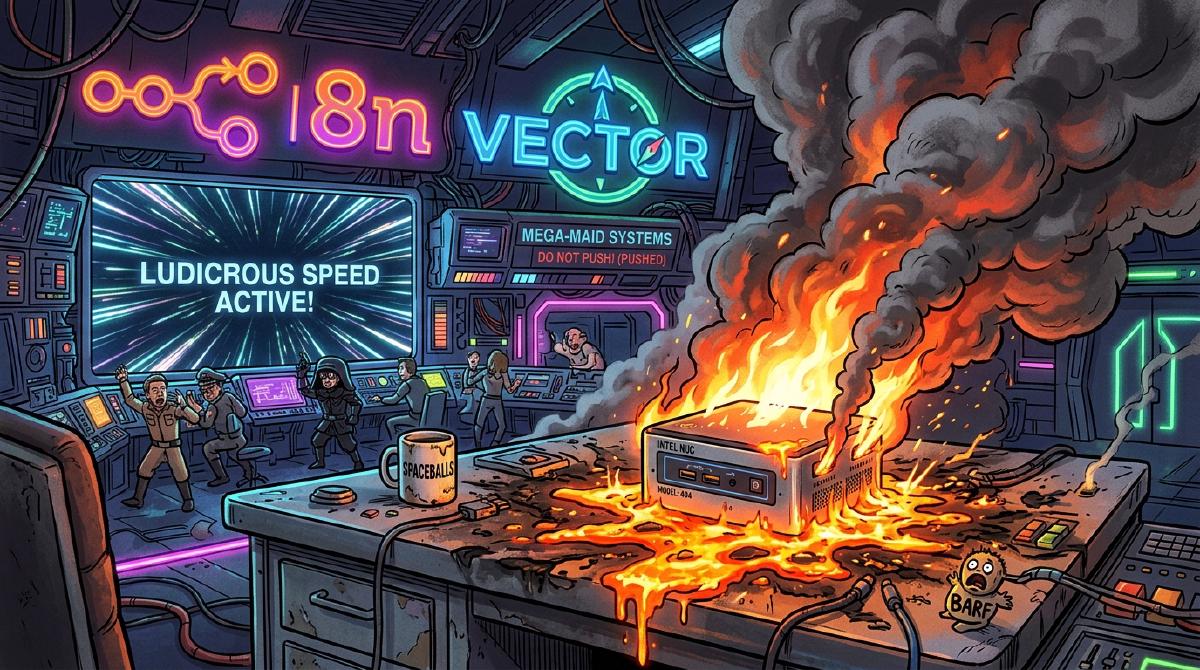
Then reality hit. And by “reality,” I mean my innocent little Intel NUC screaming in acoustic agony as its cooling fan spun at 140,000 RPM while melting into a pool of radioactive silicon.
Welcome to Spaceballs: The Log Triage. Here is everything I learned after accidentally turning my homelab into a self-inflicted Distributed Denial of Service attack.
1. How to Assassinate an Intel NUC at Ludicrous Speed#
When setting up Vector to sink Docker container logs into an n8n HTTP Webhook, I thought: “More logs = more intelligence! Let’s stream everything!”
So, I pointed Vector at 20 active Docker containers with zero rate limits, zero batching, and zero guards on the n8n webhook endpoint.
[Vector Log Collector]: "WE HAVE GONE TO LUDICROUS SPEED!"
[Intel NUC CPU Load]: 8,409.99
[n8n Webhook Queue]: 452,000 pending executions
[Thermal Sensor]: "I can't take it anymore, Captain! She's gonna blow!"
Within forty-five seconds, Vector flooded n8n with 10,000 log events per second. n8n dutifully spawned 10,000 concurrent execution instances. Each execution tried to invoke Ollama.
My Intel NUC didn’t just throttle; it achieved nuclear fusion. The fans sounded like a Boeing 747 taking off inside a shoe box.
- Batch Your Sinks: Configure Vector with
batch.max_bytes = 1048576andbatch.timeout_secs = 5. - Filter at the Source: Do not send
stdouthealth checks orHTTP 200 OKaccess logs to an LLM triage workflow. - n8n Rate Limits: Use n8n’s built-in queue mode or
Waitnodes to prevent DDOSing your own workflow engine.
2. Wazuh: “I’m Surrounded by Assholes!”#
If Vector is the engine driving us to Ludicrous Speed, Wazuh is Dark Helmet’s radar operator blaring alarms directly into your ear.
Dark Helmet: "What's the status of the homelab?"
Wazuh: "Sir! A CRITICAL SECURITY EVENT has occurred! Root touched /tmp/foo.txt at 11:04 AM! SEVERITY 15!"
Dark Helmet: "Is the server under attack?!"
Wazuh: "No sir, it's just a cron job updating the locate database!"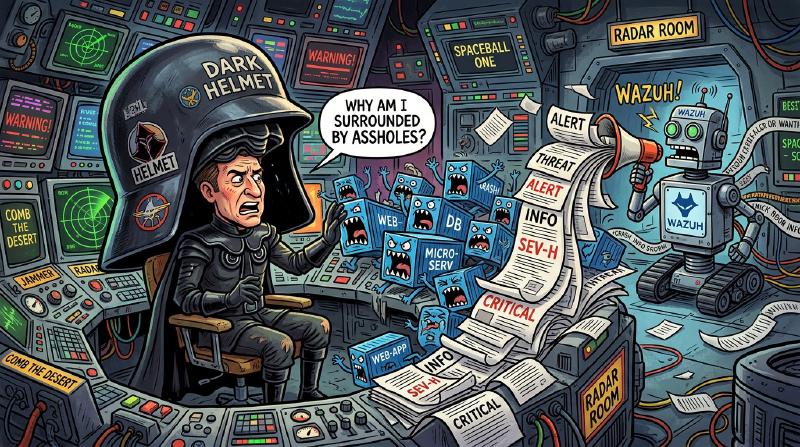
Wazuh is magnificent for SIEM security, but it is pathologically chatty.
When you pipe 20 microservices into Wazuh, and then pipe Wazuh alerts into n8n, your LLM prompt receives 4,000 lines of:
- “PAM: User logged out.”
- “File integrity monitoring:
/var/log/wazuhchecksum changed.” - “Warning: Docker socket was looked at funny.”
If you don’t aggressively filter Wazuh alerts before sending them to Ollama, your local AI spends all day writing Pull Requests to patch false positives.
3. Searching for One Clean JSON Block: “Comb the Desert!”#
My biggest naive hope when building this pipeline was simple: “Ollama is a smart LLM! It will give me a crisp, perfectly formatted JSON log summary every single time.”
Instead, calling qwen2.5-coder on a raw, un-sanitized 3GB log dump felt exactly like the desert scene in Spaceballs:
Lord Helmet: "Did you find the clean JSON log message yet?"
Ollama Llama (with a giant plastic comb in the sand): "We ain't found SHIT!"
When you feed raw, chaotic log streams from 20 different containers into an LLM without strict pre-formatting, the model gets overwhelmed and outputs:
Here is the analysis!
{
  "service": "postgres",
  "root_cause": "Wait, actually it might be traefik, or maybe a cosmic ray...
Oops, I ran out of VRAM! Goodbye!/\{[\s\S]*\}/) to carve out the valid JSON object from whatever conversational preamble the model decides to spew.4. The Mel Brooks SRE Survival Guide#
After rebuilding the pipeline from the ashes of my melted Intel NUC, here is the official Spaceballs SRE Log Triage Protocol:
- Never Stream Raw Logs to LLMs: Filter out noisy Docker services (looking at you, NGINX access logs and Wazuh heartbeats) before they touch n8n.
- Put Guards on Your Webhooks: Set up Vector throttles so a crash loop doesn’t fire 500 webhooks in 3 seconds.
- Pity the Local LLM:
qwen2.5-coderis amazing, but giving it a 50,000-word stack trace is like asking a hamster to pilot Spaceball One. Keep context prompts under 2,000 tokens. - Sanitize Everything: Assume every LLM output will contain conversational fluff, markdown backticks, or trailing commas.
Final Thoughts: May the Schwartz Be With Your Homelab#
Automation is wonderful, but only when you respect the laws of thermal dynamics and API rate limits.
We didn’t destroy the homelab—we just gave it a very dramatic, high-speed stress test. Now, Vector is throttled, Wazuh has been put on a strict noise diet, and Ollama is outputting clean, beautiful JSON without melting the CPU.
What’s your funniest automation disaster?#
Have you ever accidentally DDoS’d your own server or melted an Intel NUC with a bad loop? Share your favorite homelab horror stories in the comments below! 🎬